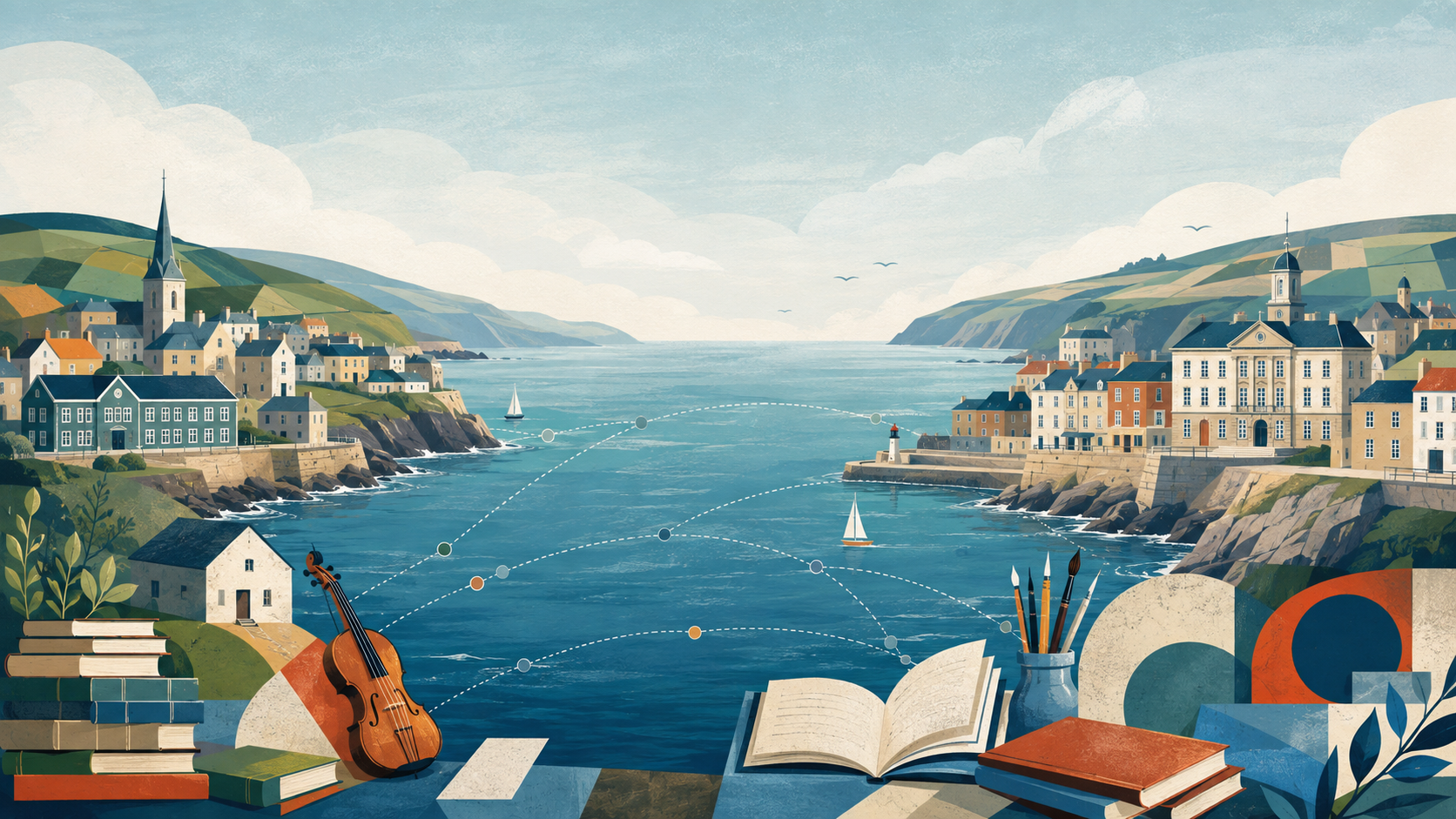
The new bilateral framework expressly recognises the role of twinnings, educational institutions, cultural organisations and local initiatives in the France-Ireland relationship.
In brief
Signed on 28 January 2026, the France-Ireland Joint Strategic Framework sets the direction of the bilateral relationship through 2030. This Joint Plan of Action covers 2026-2027 and will be reviewed annually at ministerial level.
The document rests on three pillars: a more competitive Europe; a fair, safe and sustainable global environment; and culture, civic discourse and connections between people. For prospective partners of Jumelages & Languages, the third pillar is especially relevant. It places exchanges involving students, researchers, artists, writers and entrepreneurs within the bilateral relationship and explicitly recognises the role of local authorities, twinnings and local initiatives.
Key point — The framework does not, in itself, create automatic funding or an entitlement to participate in a programme. It does, however, provide an official policy framework with which well-designed projects can align.
What the framework provides for organisations on the ground
1. Twinnings and local initiatives are recognised as instruments of bilateral cooperation
France and Ireland describe vibrant communities, civic engagement, twinnings and local initiatives as essential components of the connections between their peoples. This wording gives local authorities and twinning committees a clear basis for moving beyond ceremonial exchanges and developing sustained activities.
- For local authorities: reactivate an existing twinning, give it an annual programme or initiate local cooperation focused on a specific field.
- For associations: propose a cultural, linguistic, sporting or civic activity rooted in a relationship between two places.
- For business partners: support a visible local initiative consistent with France–Ireland links.
2. Schools have several possible points of entry
The 2026-2027 Joint Plan of Action aims to promote French-language learning in Ireland through teacher and student mobility, development of the bilateral language assistant programme and promotion of eTwinning, the European platform for establishing links between schools.
A French collège or lycée, or an Irish post-primary school, therefore need not begin with a complex trip. An initial collaboration might take the form of a digital partnership, joint classwork or a cultural learning unit, before developing into reciprocal mobility once the partners and resources are in place.
3. Vocational education and training is an area in its own right
The framework provides for stronger cooperation in vocational education and training. It cites partnerships between French academic regions and Irish Education and Training Boards, the France-Ireland Network for Culinary Arts, Hospitality and Tourism (FICAHT), and cooperation in agricultural education.
Vocational schools, training centres, agricultural colleges and sectoral organisations thus have particularly practical options: placements, exchanges of practice, learner mobility and joint projects connected to an occupation or sector.
4. Universities and research remain at the heart of cooperation
The text supports continued cooperation through Erasmus+ and European University Alliances, as well as the development of joint degrees, joint PhDs, academic mobility and scholarships. It also provides for stronger research and innovation communities, notably through European funding programmes and the Ulysses scheme.
Local projects can gain depth by involving a university, laboratory or teaching team through historical research, impact evaluation, scientific contributions, student placements or the production of shared resources.
5. Culture is approached as a field of cooperation
The plan supports government-funded artist residencies, the translation of Irish writing into French, participation in literary festivals, film collaborations and the growth of creative sectors such as design, fashion and digital arts. It also provides for events devoted to shared historical heritage, notably between Ireland and Normandy.
For artists, cultural venues, publishers and festivals, the most productive prospect is co-production: a work, residency, programme or outreach initiative designed with a partner in the other country and intended for identified audiences.
6. Sport and traditions can also provide a structure for exchanges
The framework mentions cooperation between the two national sports institutes, the growth of Gaelic Games in France, youth training, and connections in rugby and the horse industry. At local level, clubs, schools and associations can build regular exchanges around these disciplines, combining practice, cultural discovery and community life.
What our prospective partners can take from it
The 2026–2030 framework identifies the areas in which France and Ireland wish to develop their relationship. An interested organisation can therefore begin by checking three points:
- a concrete objective: language learning, mobility, artistic creation, vocational training, sport or local engagement;
- a clearly identified audience: pupils, students, teachers, artists, associations, professionals or residents;
- a genuine capacity to contribute: a designated team, timetable, host venue, educational content, local network or financial support.
Having already identified a partner in the other country is useful, but is not essential at the outset. A general intention to “do something with Ireland” or “with France”, however, must be translated into an objective, participants and an expected outcome before it can become a credible programme.
The role of Jumelages & Languages
Jumelages & Languages assists local authorities, educational institutions, cultural organisations and other bodies seeking to turn a France–Ireland intention into workable cooperation. Depending on the mandate, J&L can:
- assess the relevance and feasibility of a potential cooperation project;
- identify and approach compatible partners in France or Ireland;
- work with participants to define a programme, timetable and allocation of responsibilities;
- identify suitable funding or support schemes;
- coordinate the project’s preparation and implementation.
J&L is an independent business. Its activity aligns with the priorities described in the Joint Strategic Framework, but it does not represent the French or Irish governments and does not claim their official endorsement.
Considering a France–Ireland project?
A local authority, educational institution, association, cultural organisation or business can contact Jumelages & Languages with an idea, even if it is still incomplete. The initial discussion is used to determine whether it addresses a real need, which partners should be involved and what form of cooperation is worth developing.